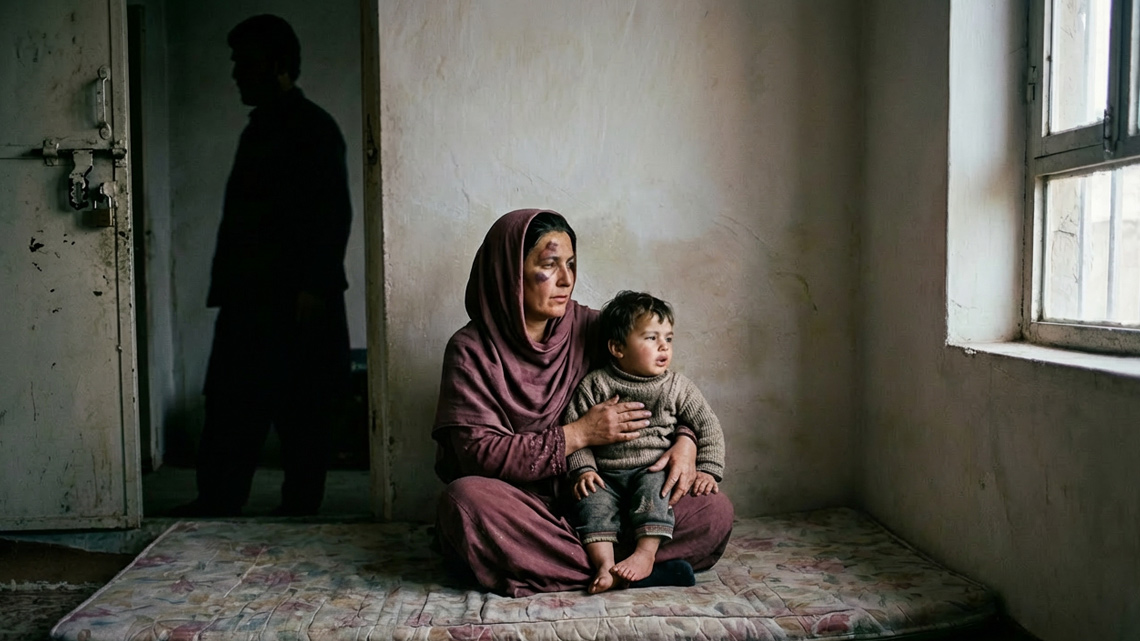
UN Women and the UN Office on Drugs and Crime (UNODC) jointly announced today (Tuesday, November 25), on the occasion of the International Day for the Elimination of Violence Against Women, that last year 60,000 women worldwide were killed, of whom 50,000 were murdered by their life partners or other family members.
This global statistic confirms the last official report on the situation of Afghan women published by the Afghanistan Independent Human Rights Commission in 2020. At that time, the Human Rights Commission stated that more than 95 percent of violence against women takes place “at home.” A few months after the publication of that report, the Republic collapsed, and no official or comprehensive report on the situation of women has been released since.
Why Is Home the Most Unsafe Place for Women?
Today, as the world marks November 25 as the International Day for the Elimination of Violence Against Women, in Afghanistan this occasion is a reminder of a reality more painful than ever before: the home, which should be the safest place for women, has now become the most dangerous living environment for thousands of Afghan women.
Domestic violence—unlike street violence—is neither seen nor reported; it is denied by families and society, and its victims remain more defenseless than any other group. A large number of women who experience violence, out of fear of social stigma, lack of economic support, fear of judgment, and weak support structures, are forced to endure conditions that destroy their physical and mental health and their human dignity.
Imagine, when the home becomes unsafe, women must live with those who are supposed to protect them—fathers, husbands, brothers, or other family members—who instead become the perpetrators of violence, while society expects them to remain silent.
The harsher reality is that domestic violence is not limited to beatings and physical abuse. Humiliation, insults, sexual abuse, denial of education and work, restrictions on economic activity, forced marriage, controlling movement, cutting off social connections, threats of divorce or taking away children—these are all forms of violence that extinguish the lives of thousands of women each year. Many of these forms of abuse were not even recognized in law under the Republic and were not taken seriously in judicial institutions.
One reason why the home is unsafe for women in Afghanistan is that our patriarchal society considers the “home” to be outside the realm of oversight and accountability, and this culture unintentionally contributes to the reproduction of violence. Many women know that if they file a complaint, not only is there little hope for fair treatment, but their own safety and that of their children may be endangered. This cycle of silence makes violence more persistent, widespread, and normalized.
The Absence of Legal Structures for Women Facing Violence
Domestic violence in Afghanistan is not a new phenomenon, but today the situation has reached a point where women not only lack safety in their own homes, but after experiencing violence, they have nowhere to seek refuge and no institution remains to hear their voices.
Since the Taliban came to power, this situation has worsened. Homes were already unsafe, but now the laws and legal bodies that once addressed the needs of women facing violence no longer exist, leaving women more defenseless than ever.
In the past, women’s shelters, police and prosecutor’s offices dedicated to addressing violence, the Ministry of Women’s Affairs, and the Afghanistan Independent Human Rights Commission—despite shortcomings and limitations—at least offered a window of legal and social support. When women were beaten, threatened, or their lives were in danger, there was at minimum a place they could go to seek help, find refuge, have their voices heard, and sometimes be saved. But with the Taliban takeover, all these legal and political structures were abolished, and the entire system of legal and administrative protection for women collapsed.
The shelters that had been created to save women’s lives were shut down, and many women who faced violence were forced to return to the very homes where their lives were at risk. The Ministry of Women’s Affairs, which was the only government institution responsible for legal follow-up and support for women, was dissolved and its building handed over to the Ministry for the Propagation of Virtue and the Prevention of Vice. The Afghanistan Independent Human Rights Commission, which had always served as a source of reporting, monitoring, and advocacy for women, was also shut down. Today, women experiencing violence do not even have a single official office where they can file a complaint. In many cases, the Taliban have even forcibly returned women who reported violence back to their homes, into the hands of abusive husbands or fathers.
The result of this structural collapse is the complete silencing of the cycle of data and information regarding cases of violence against women. In the past four years, there has been no official or nationwide data on the situation of women facing violence in Afghanistan—not on the number of victims, the types of violence, nor the social and psychological consequences. Violence that was once at least recorded and reported now remains behind closed doors, in silence, without being documented.
On the International Day for the Elimination of Violence Against Women, the world must understand that Afghan women are not only victims of violence; they are also victims of statelessness, abandonment, and enforced silence. Because in Afghanistan today, the home and the street, police stations and the courtrooms of the Taliban—none of them differ from one another; all are places where women may be subjected to violence. For this reason, it can be said that until a democratic and accountable system comes to power in the country, until Afghanistan’s current misogynistic culture is transformed, and until women gain the rights, freedoms, and authority they need in both home and society, there is no escape from this state of defenselessness. This is a wound that grows more painful and dangerous every day, and with each passing year, we will witness a rise in the statistics and types of violence against women.