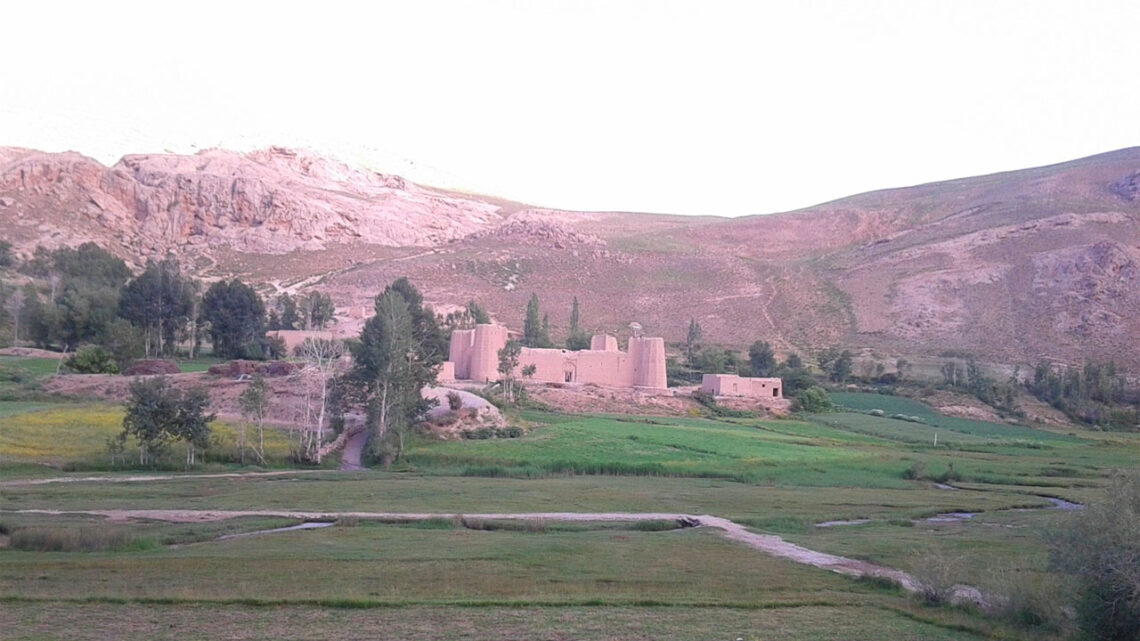
As Laila sits on a platform, spinning wool, she gazes out at the picturesque, golden sunset and heaves a deep sigh. Wrapping the wool thread around a small stone, she packs up her chador. The phone hanging from the corridor pillar rings. “Hello, hello…,” Laila answers. “… The children are fine, but we don’t have enough to eat. Will you send us money or not? If not, I’ll have to beg after this….”
After the phone hangs up, Laila stands in stunned silence for a moment before slowly retaking her seat on the platform. Still avoiding eye contact, it seems as though my questions have either upset her or are simply too heavy for her to bear. After a prolonged pause, she finally gestures towards two or three barren plots of land in front of her, and utters a heartbreaking story: “I became a victim of these lands; lands from which not a single grain of wheat has been consumed by either side.”
As Laila and I continue our conversation, I notice her sons and daughters peeping from behind the door and window, eavesdropping on our exchange. In the darkness of the night, we intend to have a flashback to the dark recesses of Laila’s childhood memories, retracing her steps as a three-year-old girl accompanied by her five-year-old brother. It was a time when Laila and her brother had lost their mother and found themselves in the care of their stepmother. With the arrival of new babies one after another, little Laila was tasked with handling all the household chores. But this was not her only trouble. Laila’s father sent her and her brother to work as shepherds and farmers for their neighbors, with their meager wages helping to sustain their own household.
As the years went by, Laila’s suffering and hardships only multiplied. By the time Laila became a teenager, her uncle, a village elder, found himself embroiled in a bitter dispute over property and land with a powerful neighbor named Shah Jafar. Since Shah Jafar was a powerful man and had connections with government officials, he won the case against Leila’s uncles and father and gave them a deadline to leave the village. Despite Laila’s family’s attempts to obtain land equivalent to three houses in size, Shah Jafar remained obstinate in his desire to claim the entire disputed land.
“It was winter, and the snow was falling heavily,” Laila remembered with a lump in her throat. “The news of my father and uncles’ eviction had spread in the village, leaving me and my family terrified and uncertain about what would happen to us, including my sisters and my uncles’ daughters and wives. Through the mediation of the villagers, Shah Jafar agreed to our stay in the village, but the condition was beyond shocking: my father had to give me away to Haidar, Shah Jafar’s son, who was 35 years old and I had just turned 20. Everyone was taken aback by this proposal, and I could never have imagined it happening to me”.
On the one hand, Laila’s family’s life and the lives of her relatives were hanging by a thread, and on the other hand, she was deeply in love with a boy named Farhad for three years. Farhad’s home was in a village located far away from Laila’s home village. Their love was so intense that Farhad walked for two days and nights until he reached her home village in the middle of the night. He made the same journey for two years, and they could only meet two or three times at his sister’s house (who was married to my uncle).
Leila’s emotions run high when the subject of love arises, and her eyes well up with tears. “Farhad and I had made a vow to marry each other,” she says, her voice hoarse and her eyes filled with tears. “I waited for his return from Pakistan, and in my determination to keep that promise, I did everything in my power to prevent my marriage to Haider from taking place.”
All eyes are fixed on Laila’s uncle, as he is the family’s elder and holds the ultimate authority in the family. Inevitably, he agrees to the marriage to avoid uprooting the entire family from their village.
Meanwhile, Shah Jafar and his tribe, along with his sons, visit Laila’s father’s house armed, demanding that Laila be handed over or they leave the village.
In a desperate attempt to escape this fate, Laila contemplates suicide but is prevented by her father and stepmother. Despite this, she is repeatedly beaten by her uncles and father and imprisoned in a hayloft until she is finally left with no choice but to agree to marry Haider.
The night of the wedding, Laila is taken away with cheers of victory, as if they had gained a spoil of war. But just a few nights later, Laila throws herself out the window and escapes from Haider’s house in the middle of the night. The night is enveloped in darkness and the air is chilly. The barking of stray dogs grows louder and closer, causing Laila to fear for her safety. She worries that the dogs might pounce on her at any moment.
But Laila has nowhere to go and no one to turn to. She cannot go to her father’s house due to her stepmother’s hostility, nor to her elder uncle’s house, who had agreed to her marriage. Challenging his decision is a blow to his reputation. Inevitably, she seeks refuge at the house of her second uncle. Her second uncle’s wife was Farhad’s brother, whom she had promised to marry.
As Laila hides in her second uncle’s home, the crackling of gun fires echoes throughout the area, causing everyone to wake up frightened. Shah Jafar arrests and tortures Laila’s father and uncles on the charge of stealing Laila, even though they know nothing about her escape. Shah Jafar and his sons go from house to house searching for Laila until they finally discover her hidden in a box under grass in a hayloft.
Laila is once again caught up like a helpless prey ensnared in the jaws of a wolf, taken back to Haider’s house with torture and cursing from her uncle’s home. Haidar’s house is guarded by armed men for several months to prevent further escape attempts. Laila gives up hope of ever reuniting with Farhad and resigns herself to the imposed and grueling life with Haider.
Farhad, unaware of Laila’s plight, continues to work hard in Pakistan, hundreds of meters underground in a coal mine, to earn money for the bride price. It is not until Farhad’s maternal uncle visits Pakistan and informs Farhad about Laila’s marriage. Brokenhearted and despairing, Farhad decides to march to Haider’s house with his brothers to take Laila by force, even if it means shedding blood. But Laila’s father and uncles vehemently oppose this decision. Farhad is unable to take any action at least due to his sister and reluctantly departs from his homeland, heartbroken and filled with despair.
“I haven’t lived for years”, Laila says, while her hands are numb and her arms are shaking from crying. “I burn day and night like a piece of wood of the fire. I have been forcibly raped for years. I hate my children, who are the result of this forced relationship and rape. My husband is in Iran and he is enjoying himself there. But we don’t have our morning and evening bread here.”
Laila’s sons and daughters leave the room and gather around their mother. The heavy silence of the corridor is broken by the heartbreaking cries of Laila and her children, and I, who have exhausted my patience, join them and cry for a woman who is a victim of baad and every relationship is as painful as rape for her.